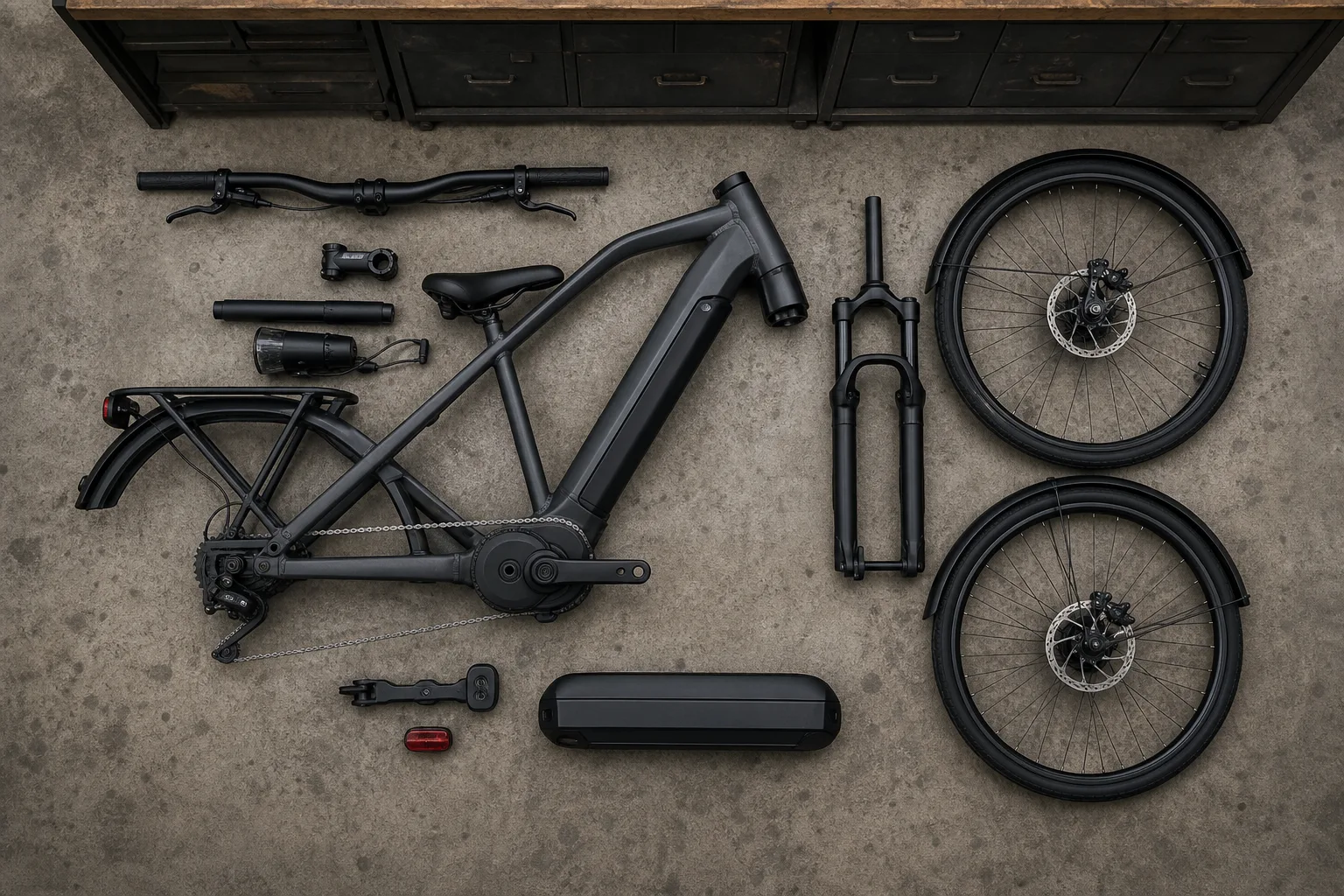
A test ride flatters almost every electric bike, because the motor is doing the part of the job that used to be hard, and the extra mass sits underneath you where it reads as stability rather than burden. Nothing in that ten minute loop tells you what happens at the curb outside your building, on the hitch rack at shoulder height, or on the half flight of basement stairs you take twice a day. Assembled weight is the specification that follows you home, and it is the one almost nobody checks in the store.
Where the pounds actually sit
Two bikes can both weigh 58 pounds and behave like different machines, because the arithmetic that matters is not the total but the distribution. A rear hub motor puts five to eight pounds inside the back wheel, which is unsprung, low, and directly over the rear axle, so the bike leans away from you when you tip it and wants to swing its tail on a stairwell landing. A mid-drive puts a similar mass at the bottom bracket, between your feet, close to the frame's center. The battery is the bigger variable: an in-tube pack keeps seven to ten pounds along the spine of the bike, while a rack-mounted pack sits high and far back, which is the least helpful place for it.
You feel that difference in three specific moments. Lifting the front wheel onto a curb, walking the bike sideways in a hallway, and setting it on a rack tray where you have to hold the balance point steady with one hand while the strap goes over with the other. Center-heavy bikes forgive all three. Tail-heavy bikes make you work.
The tests to run in the shop
Ask to lift the bike by the top tube, one hand, about six inches off the floor, and hold it for a slow count of five. If the frame has no top tube, which is true of most step-through commuters, find the balance point on the down tube instead and note how far forward or back it is. That single lift tells you whether you can get the bike onto a rack, into a truck bed, or over a threshold without a second person. Then walk it up one step, both wheels, using the handlebar and the saddle. Then lower it back down, which is harder, because gravity is now on the wrong side and rim brakes or hydraulic levers are awkward to squeeze while you brace.
Do all of this with the battery in, and then again with it out. A removable pack is the difference between a 58 pound lift and a 50 pound lift, and 50 pounds is a threshold a lot of riders can manage when 58 is not. Check that the pack releases with one hand and a key, not two hands and patience, and that the latch is reachable when the bike is leaned against a wall.
What a flat battery does to the number
Every electric bike is a heavy analog bike once the charge runs out, and the cheap way to learn this is a mile from home in a headwind. Mid-drives coast and pedal fairly normally when dead, because the motor spins with the drivetrain and the gearing still helps you. Geared rear hubs freewheel cleanly too. Direct-drive hubs, the quiet ones with no internal clutch, add magnetic drag you can feel on every stroke. If you plan trips at the edge of your range, ride the bike in the shop with assist off, on flat ground, for a block, and decide whether you would accept that for two miles.
What a lighter frame costs, and where
You can buy your way down to the low 40s, sometimes the high 30s, and the money goes to aluminum shaped more expensively or carbon, a smaller battery, a smaller motor, and lighter wheels. The trade is usually range and cargo capacity, so a 40 pound bike often carries a pack good for shorter trips and a rack rated for less weight. That is a fair swap if your errands are three miles and your storage is upstairs. The Consumer Product Safety Commission oversees bicycle safety requirements in the United States, and frame and rack load ratings are worth reading rather than assuming, particularly on lightweight builds where the numbers are genuinely lower.
Weigh the choice against your real week. A slightly shorter range that you can carry beats a long range you have to leave outside.