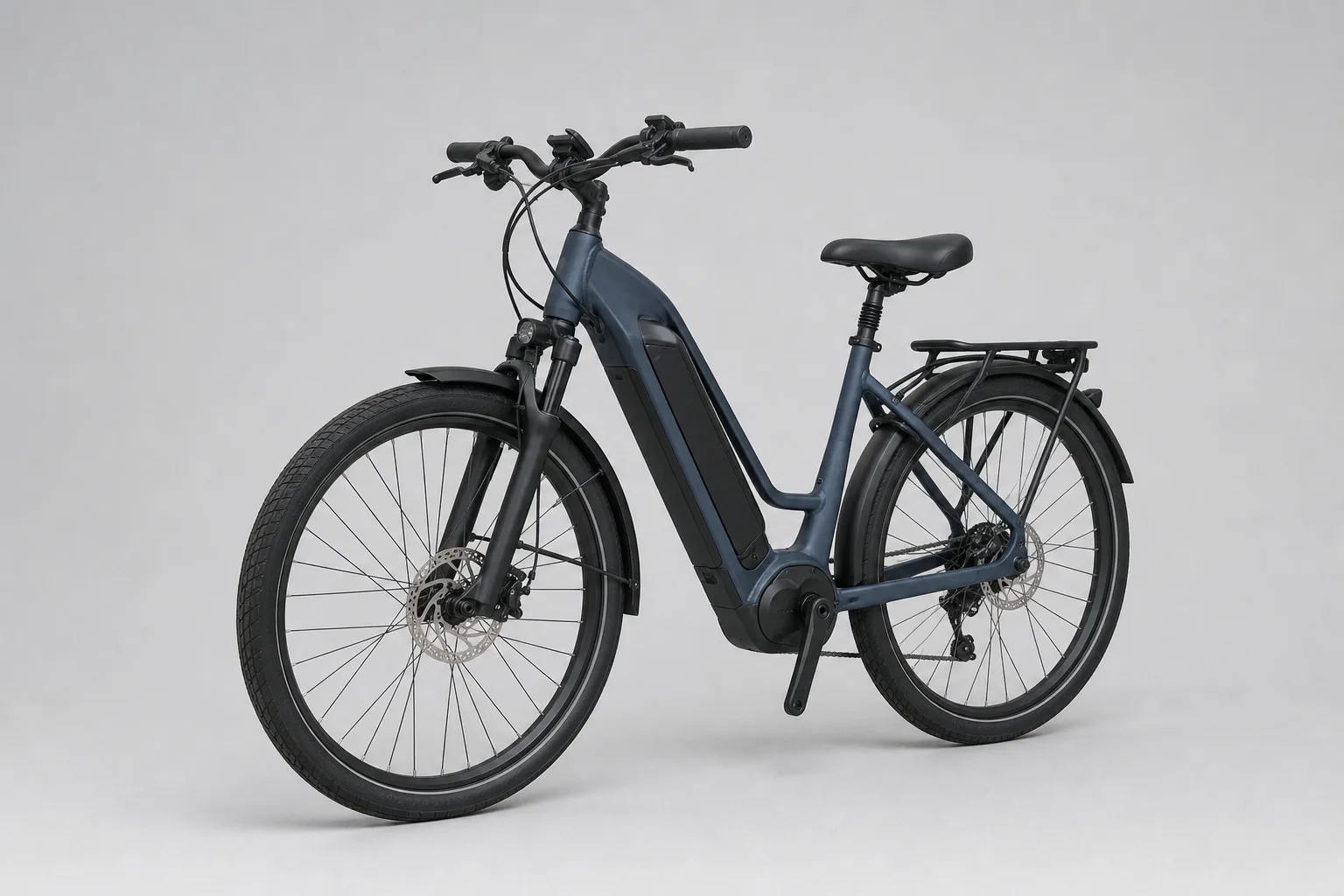
Advertised range comes from a flat loop, at the lowest assist setting, with a light rider, warm weather and full tires. Nothing about that is dishonest, and nothing about it describes a Tuesday afternoon with groceries on the rack and a quarter mile of climb between the store and the house. The useful move is to stop reading the range claim and start reading the battery's capacity in watt-hours, because that number is fixed and the rest is arithmetic you can do yourself. Once you can do it, comparing two bikes gets much simpler.
Watt-hours on the flat, and what a climb takes back
On level ground with moderate assist, most everyday electric bikes draw somewhere in the range of ten to twenty watt-hours per mile, and you can confirm your own figure by watching the display over a week of normal riding. A 400Wh pack at fifteen watt-hours per mile is a little over twenty-five miles. Climbing changes the math because lifting mass against gravity is real work: hauling a loaded bike and rider a hundred vertical feet costs on the order of ten watt-hours once motor and drivetrain losses are counted. Three hundred feet of climb in a five mile errand is a meaningful bite, not a rounding error.
Weight, assist level and tire pressure compared
Of the variables under your control, assist level moves range furthest. Riding at the top setting can consume two or three times what the lowest setting does over identical ground, because the motor is doing the share of the work your legs would otherwise cover. Rider and cargo weight matter most on grades and least on the flat, where rolling resistance and wind dominate. Tire pressure is the cheapest fix available: soft tires bleed energy on every rotation, and a floor pump with a gauge, used every couple of weeks, recovers range that no larger battery would have to supply.
Cold weather, and why winter range is not a fault
Lithium cells deliver less usable capacity when they are cold, and the effect is temporary rather than permanent. A pack that covers twenty-five miles in September may cover closer to eighteen or twenty on a hard January morning, then return to normal in spring. The practical answers are to store and charge the battery indoors, to bring it inside overnight rather than leaving it on the bike in a garage, and to plan winter trips against a shorter working number. The Department of Energy oversees federal research on battery performance and vehicle efficiency, and temperature sensitivity is a well understood property of the chemistry, not a defect in a particular bike.
400Wh against 500Wh for errands under ten miles
For a rider whose typical outing is under ten miles round trip, a 400Wh pack is usually the better buy, and the reason is weight rather than money. Battery mass sits high and rearward on most frames, and the difference between a 400Wh and a 630Wh pack is a few pounds that you feel every time you lift the bike onto a rack, wheel it up a curb, or catch it as it tips. A smaller pack on a hilly ten mile route, with cold weather and a load, still leaves comfortable margin. Buy the larger battery only if your genuine routine, not your imagined one, needs it.
What a careful reader checks before buying
Check the watt-hour figure rather than the voltage or the amp-hours alone, since watt-hours are the two multiplied and the only number that compares across systems. Check whether the display shows watt-hours consumed or only a five-bar fuel gauge, because bars tell you very little at the moment you most want detail. Check the elevation on the routes you actually ride, using any mapping tool that reports total climb. Then check the price and availability of a replacement pack from the manufacturer, and whether the battery detaches for indoor charging, which is the single feature that most protects range through a cold winter.
The charge cycle that suits most errand riders is a partial one: top up every few days rather than running to empty and back to full, keep the pack somewhere near room temperature, and treat a full charge as something you do the night before a longer trip. Batteries used this way age slowly and stay predictable, which is worth more day to day than any advertised maximum.